I took this trip to Alaska to visit my friend T back in 2016, created the post for it a few weeks later, then got distracted by other activities, and never published it. So here it is, better late than never. T left a note awhile ago on my Facebook page where I
had posted some photos, “ Where's the narrative?” In my mind I
answered her: “Cooking. Not yet ready to be served.”
Et voila. Le diner est servie.
Taking Off
In Fairbanks, I stay at T's house,
which is a magnificent expansion compared to my space in crowded San
Francisco. This is what T calls “in town”, what she can't wait
to get away from while she's there, so she can go out to her cabin in
the wilderness. That's where she is now, with her boyfriend,
stomping around in snowshoes fixing the place up. (Actually I've
never worn snowshoes so I'm not really sure what you do in
them...stomp? Glide? Mush?) At any rate, they are where I'm
headed. And in the meantime, I sleep downstairs on the couch in a
wonderful big empty house, facing the window, staying up to watch the sun go down
around 11PM, and waking with it already shining in my face.


T's friend T2 shows up to feed the
chickens which T keeps in a chicken house just below the main house.
Unfortunately, I have already eaten almost all the cooked white rice
that was left on the pot for them, thinking, “Oh, how thoughtful
that T left me dinner!” T2 is a transplant from California, so we
can both talk and nod about how strange Alaska is to people from
California. Mostly, for her, she is bothered by the long dark days
of winter. I can't say I blame her: one of the reasons I choose
to come up here now, in the spring.
T has left a mammoth shopping list of
stuff to take out to the cabin, so T2 is my driver and co-shopper in
this adventure. She and I were created in the same factory of
absent-mindedness and spatial disfunction, so on the road we end up
driving around in circles and yelling at Siri, and once inside the
mammoth big box stores of Fairbanks, we wander the aisles with lists
in hand for what seems like hours.
I don't like shopping, but I appreciate
having T2 along with me; she's a good companion.
Back at T's, we load all the stuff onto
a sled and slide it all slowly down the snowy slope to T's house,
careful not to slip and fall on our butts.. Actually, we do this mammoth shopping escapade over a period of several days, which is probably why
it invaded my dreams, but more on that later. Mostly it's
foodstuffs, enough to last for the six weeks T and I will be out
there, along with other important items like wheelbarrow tires and
plastic storage tubs.
Voices and Memories
During the few days I am in Fairbanks,
T calls me periodically from her satellite phone to request more
stuff that she didn't put on the list: batteries, food, tools. The reception is bad, and we
frequently get cut off, but it's good, as usual, to hear her voice.
This is
basically all I have known of her for the past eleven years: the
sound of her voice over the telephone. For the last forty years of
our friendship, we have only seen each other about once a decade.
We met in high school in Bellingham, WA when we were sixteen, and
immediately created our own private club, membership of two, doing self-consciously self confident sixteen year old things like using the boys' bathroom to smoke
our cigarettes, and sitting under the table at the local diner to
drink our coffee instead of at the table on chairs like we were
supposed to. We were brilliant, we were rebels, we took LSD
together and saw god in a bowl of adolecent laughter, we were
sixteen. She, freshly arrived from Alaska, always wore a big orange
pumpkin parka and I teased her about hiding her Cinderella inside a
pumpkin. I, freshly arrived from California, ran around shivering in
the snow looking like L.A. in a green miniskirt with my skinny legs
sticking out.
Later, in our twenties, we spent time together on the
road in Barcelona and Paris, working late hours in nightclubs and
staggering one night after work into a photo booth and taking our
photo, my arm around her, our heads cocked together, smiling bravely
into that singular moment of light. I now have the photo, which had
been in T's posession for many years in her cabin on the Kantishna
river. No, I'm not going to show it to you, because the mysterious
Miss T prefers not to be shown these days, so I will respect her
wishes.
After our wild wandering days in
Europe, T pretty much settled down and got a respectable career, and
I didn't. At one point she called me while working her respectable
career and spending all her money on the corporate suits she had to
wear to work every day to tell me how miserable she was doing that
and how all she really wanted to do was go back to Alaska and build
herself a cabin in the woods and live in it.
And so she did. And that's where I'm
headed. “Wheelbarrow tires,” she says on the phone, her voice
filled with the static of distance, “You can pick them up at the
hardware store.”


To the Bush
T and I have had some phone calls back
and forth about how I may or may not be able to actually fly out and
join her in the bush, because of bad weather or the ice melting too
quickly, so I am reluctantly prepared to spend the next six weeks
hanging around Fairbanks if I have to. But the pilot calls me to
give the go-ahead, so before I know it I have said goodbye to T2 and
am high in the air looking down at the wild but strangely elegant
markings of Alaska down below. The pilot announces ahead of time
that he'll need to stay focused, and won't be able to chit chat
much, so we fly in silence together, hearing only the sound of the
motor. That's fine with me.
Next life, I'm coming back as a bird.


Landing
I step off the plane. The day is
beautiful, snow on the ground, air fresh with light, the Kantishna river icy flat, smooth and white. T is there, bundled in a parka,
as well as her boyfriend R, equally bundled. They've got a sled to
pile the stuff onto, and a big happy dog who bounces around unbundled
on top of the river ice.
Although it's been eleven years since
I've seen her, she honestly doesn't look that much older than the
last time I saw her. But part of that I'm sure is because we all age
at the same rate, which can sometimes produce a kind of time warped
optical illusion. She has recently been ill, so I was expecting
worse. But she looks amazingly strong.
The last time we met up here, eleven
years ago, she took one look at me and said, “My we certainly have
aged haven't we!”
I was glad she didn't say that this
time, although, on the other hand, I really don't give a hoot. I
guess by now we are both taking the ageing part in stride and don't
even comment on it.
We unload the stuff onto the sled, and
her boyfriend R takes my place in the Bush plane and heads back with
the pilot to Fairbanks.
When we were sixteen T once went for a
psychic reading and the psychic told her that she and I would be “old
ladies together.”
So here we are. Not old of course,
because nobody I know, at any age, ever seems to admit to that, but
respectably close.


Disappearance
We drag the stuff into the cabin and
unload it. T is concerned because the other dog that came out with
them has disappeared. He ran off into the woods a few days ago and
never returned. He was old.
“Maybe he just wanted to go out into
the woods and lie down and sleep,” I said.
“Maybe,” she said. “I hope
that's what happened to him.”
The next day, T took off and waded
through thick undergrowth and snow up to her hips for several hours,
and then returned.
“I can't find him,” she said. She
was breathing hard, her face red.


About the Body
Of course, after we settled in, we had
to spend time 'catching up', face to face, not over the phone.
Talking is something we've always been good at, a long communication
that has now gone on for several decades. I didn't know when I
was sixteen how important it would be to have people like her still
around in my older years. Witnesses, accomplices, pieces of the
jigsaw puzzle I call my life. She remembers stuff I don't, and vice
versa. We talk and laugh, adventures and challenges we have had in
the past decade, my trip to Peru and across the country, her life
here in Alaska, people who have come and gone from our lives, old
memories.
Inevitably, we begin to talk about the
body.
What has come into both our lives in
the past eleven years has been a real sense of the time limit on our
physical bodies. I really think of our bodies like vehicles; when
they are new, we run them ragged, we show them off; over the years,
they get us where we are going, then they begin to break down, and
eventually, they stop. Her ailments have been more dramatic, some
of it no doubt the culmination of a lifetime of overconsumption of things that are not good for you. My own, more mundane: a too long recovery from a broken
arm, an undiagnosed hypothyroid condition which dragged me down into
long periods of fatigue before I was able to correct it.
And this, and that. Yada yada yada.
As a teenager, I used to hate the part where older people began talking
about their bodies.... I mean, really who wants to know?
And yet, here we sit, on the verge of
old ladyhood, swapping exciting tales about our illnesses and their
cures. But the worst of it is not that I am doing it but that I am
actually finding it interesting, comparing symptoms and remedies like
we used to trade stories of our love affairs. “Reallly? And what
was THAT like...what did you do then?”
For a long time, probably too long, T
never went to doctors, saying “Nope, don't wanna do it, because
once they get their hands on you, they never let go.” And, in her
case, it proved to be true. She now sets an enormous plastic bin
full of vitamins and pills on the table and insists, for good
measure, that I take some too.
Last year after she discovered she had
Hepatitis on top of everything else that was wrong with her, she was
talking about making me executrice of her will.
Why don't you come up here and marry my boyfriend after I die, she urged, he's a good guy. (T always wants to make sure everyone is taken care of. )
She didn't want to go through nine months of the Hep treatment from hell, she said, and everything else was falling apart too, might as well call it quits. The shorter, more painless treatment was three months and cost $90,000 without insurance. She wasn't sure her insurance would cover it. But she ended up getting it covered, and miraculously, here we are now, sitting across from each other at the wooden table, talking about life and not death.
Why don't you come up here and marry my boyfriend after I die, she urged, he's a good guy. (T always wants to make sure everyone is taken care of. )
She didn't want to go through nine months of the Hep treatment from hell, she said, and everything else was falling apart too, might as well call it quits. The shorter, more painless treatment was three months and cost $90,000 without insurance. She wasn't sure her insurance would cover it. But she ended up getting it covered, and miraculously, here we are now, sitting across from each other at the wooden table, talking about life and not death.
We are here, at the cabin on the
Kantishna river, to watch and celebrate the spring.


The Routine
Eventually our swapping of stories dies
down to some degree and we settle into a routine. I am sleeping on
the fold-out couch in the living room area of the cabin; T sleeps in
an alcove. Subconsciously, we seem to adjust for our need for
privacy by changing our sleeping schedules: at home in SF, I go to
sleep and wake up early, but here, to have a few hours all to myself,
I stay up later at night, and she gets her alone time early in the
morning, while I sleep with an eye mask on to block out the increasing light.
T knows that I want to spend some time
writing up here, and is gracious about waiting for me while I write
and there is work to be done around the cabin, which there always is. Most of all, there are dead trees lying around that need to
be limbed, cut up with a chain saw, and hauled in wheelbarrows to the
growing woodpile in front of the house. So we do a lot of that. T
knows about my sometimes awkward relationship to the physical world,
so she takes over all the chainsawing, which is fine by me. I do a lot of limbing and hauling of both wood and water, which in the
middle of the woods, has a certain zen peacefulness to it, though my
back does not always approve of my desire, or my need, to haul water,
chop wood. So there are also a few hours spent popping painkillers
and lying on the sofa unable to do much of anything, which those Zen
books never tell you about.

T insists on doing all the dinner cooking, and
because of that, we eat very well, from the stock of frozen food
which is in a big tub a covered area behind the house. She is one
of those people who begins to plan for dinner in the morning, whereas
I in my citylife will usually just throw something together
haphazardly or go out to a restaurant. Eventually, as the snow
melts, we realize the food will thaw unless we do something, so, while there is still snow on the group, I fill up ziplock bags with snow every day and stuff
them into the cooler to keep everything cold.
Ziggy the dog insists on his walks so
every day there is at least one walk to the river. This is where
extraordinary things happen.
The River
“I really want you to experience
Break-Up,” T had said for years before I finally got my ass up to
Alaska for the spring. Break up is what the river does when it
thaws; the long road of ice that we landed on begins to form puddles
and rivulets, and then, in an amazing dance, the chunks of ice begin
to break off and go rushing down the river, along with logs, limbs,
unexplained flotsam and jetsam, which sometimes formed into
magically strange creatures, semi-transparant turtles and dragons and
half-ruined castles, illuminated by the sun, all whooshing
downstream together.
This, T said, was a 'gentle break-up'
compared to years past. Here are some stills and video of what that looked like: 


The river is also the place where,
later in the spring, the birds gather: ravens, and wild swans,
ducks and seagulls.


Dreams
I am hoping that my psyche will take
a cue from the river and that my interior world, the world of dreams
that has been put into a semi-deep freeze while I ran around earning
a living in San Francisco, will thaw, and the dragons and castles of
my own dream world will magically return. Last time I was here, it
happened that way, my dreams took on the bigness and the wildness of what was around me: After eating moose
heart for the first time, for example, I dreamed of being a wild
moose, running through the woods. But this time, it takes awhile for my interior to adjust to my exterior. For three weeks, I dream about being lost in urban shopping malls. Perhaps my psyche is just
doing some deep cleaning, and I am only remembering the flotsam and
jetsam that is being washed ashore. I don't know. Eventually, however, the shopping mall dreams stop. it does feel as if I am beginning to breathe more deeply, in real life as well as in my
dreams. T has one dream while we are out there: in it, she loses and then finds her potholder.


Trees
The transformation of the trees is no
less magical than the break-up of the river. When I arrive, the
ground is still covered with snow; everything is white; white snow,
tall, elegant white birches. Gradually, little flecks of green began
to appear like paint on the distant trees, and I wish staring out
the window, that I could paint, feeling that what is really needed
here is pointillism, not photography. Up close, the leaf-buds began
to form, then unfurl, then announce themselves in all their lush
brilliance as spring arrives.


Flowers
The roses start out as nothing but
stark thorny stalks, beautiful in their own ragged and luminous way
as they emerge into the sunlight. Later, the buds began to form and
T and I walk every day to examine a clump of rosebushes growing
along the river that she begins to call “Lisa's garden”. We visit it every day, hoping the roses will bloom before we return to Fairbanks. That doesn't happen, but there are Alaskan roses in full
bloom waiting for us there when we return.
Bluebells, or chiming bells, are the
other flower that grows in abundance here in the spring. The flower
essence for this flower is “Joy in Physical Existence”.


The History of Civilization

In the cabin, I actually start reading
books again. In the last few years, my brain seems to have been
overtaken by the Internet. But there is no internet here, so I am
forced back in time to the weight of the book in my hand, the feel
and smell of paper. It feels good. On a shelf in the corner, T has
the entire series of Will Durant's History of Civilization. I
figure that's a good a place as any to start.
In many ways, being here is certainly
like moving back to the 20th and in some ways, the 19th
century. We have the advantages provided by the bank of
generator powered batteries that sit on the floor along one wall of
the cabin: electric lights, a Satellite phone, computer and VCR.
But we have to parcel out our electricity use, only so many hours of
computer usage, one movie a week. Every couple of days, a visit out
to the back of the house to refill and re-start the generator. And
the generator itself barely survives our visit. Towards the end of
our stay, it is coughing and sputtering and we have to tease it into
doing anything at all, the electric lightbulbs in the cabin dimming,
replaced by kerosene lamps.

I dip in and out of the volumes of Will
Durant: the Biblical Era, 10th century, 14th
century. War, politics, religion, family, hunting, agriculture, food. Other than the
electricity, and the fact that we have a storage shed filled with
store-bought food that we have flown in, we are living the way
people have lived for centuries: four walls and a wood fire to keep
us warm, hauling water into the cabin from drainbarrels filled
with rain. Chopping and hauling wood to stock up for winter.
Weapons nearby—in this case a shotgun leaning against the door and
a holstered .38 on my hip---to scare off any wild animals (in this
case bears) that might want to compete with us for our food.
T is
fully in her element here; she says she wastes too much time in town
drinking vodka and staring into computer video games; she likes to
be pushed up against her own resources out here with just the elements of nature, it makes her feel alive.
I understand this, but the visit also makes me appreciate that I
don't have to handle these day to day elements of survival in my
urban 21st century life, where water comes out of a tap,
and light comes from the flick of a switch.
I also recognize that progress has
brought us into a kind of fog of invulnerability, a disconnectedness
from 'the big picture'. We can spend our entire lives working
frantically on our little piece of the jigsaw puzzle, sometimes not
seeing either the pieces around us, the big picture that surrounds
us, or the fragility of the whole construction. And then: poof!
it's gone.
Here at least, out in the woods, I am
reminded of the eternal rhythms of nature and our human place in it:
the sound of the river rushing, the soft thud of my step on melting
snow; ax hitting wood while I limb another branch from a tree, the
weight of a log in my arms, Raven calling in the distance.
I dump the log in the wheelbarrow,
raise my voice and call back.
Openings

Spring arrives here like a fierce but
elegant woman, taking her time as she moves slowly through the tall
spruce trees and birches. Standing by the river, you can hear the
sound of water beginning to break free from its ice prison, a slow
gurgling, an occasional crunch of ice breaking off and falling into
the water. Chunks of ice glint in the sunlight. From one day to the
next, vast swatches of water are unbound, and begin to flow freely.
When I arrive in early April,
the silence is stunning. It is that cool, all-enveloping silence of
snow, broken only by the occasional,impatient scolding of the two
squirrels who seem to never sleep and chase each other back and forth
among the trees. By May, the sounds of spring are breaking through:
ravens, geese, even an occasional songbird. Snow is melting,
replaced by increasingly large patches of earth, budding with
broomrape, the stems of wild roses, mushrooms. It is
nothing like the wild cacaphony of spring that explodes in California:
here, in Alaska, every new sound is discrete: a surprise, and a treasure.
The space and silence opens up a
freedom between the ears: not only spring, but the thinking spaces
awaken, taking flight like the flock of wild cranes that occasionally
soar overhead.

Doing Stuff
Out here, when we are not talking or
reading, we Do Stuff. I capitalize these words because it is a
different kind of Doing Stuff than I am used to. In my San
Francisco life, my doing of stuff sways in a fluid but sometimes
chaotic way between the concrete and the abstract, it frequently
involves multi-tasking, or thinking about one thing while I am doing
another. I cook breakfast and think about what class I am going to
teach that day or what I need to do on the film I am working on; I
head out into the day in my car, listening to NPR, watching
traffic, catching a bird sweeping over a San Francisco hill, a woman walks down the sidewalk in a red hat, and I wonder what she's thinking,
oh shit, what time is it, am I going to be late for class, did I
remember to bring my cell phone, damn fool in front of me didn't
signal his turn, wonder if I have enough Starbucks rewards for a free latte, why the hell Donald Trump, etcetera etcetera.
It's the way many of us live these days. Multi-tasking. All over the
place.
The gift of six weeks in the Alaskan
Bush with no one but your good friend and a dog named Ziggy is not
just the beauty of the environment or catching up with your friend,
it is the simplicity of your Doing Stuff. Wake up. Eat breakfast. Write (in my case). Read (in hers.)
Eventually someone (usually her) says, “Well we got a lot of wood
out there to bring in.” Or: “Generator needs charging.” Or:
“Need to bring in more buckets of water.”
Here, I enjoy how I am able to cut down my Doingness of Stuff to the bare essentials: Chop wood. Haul water. Watch flowers grow. Take dog for
walk. Cook. Eat. Sleep. My mind, slowly, begins to unite with my body, and I begin to feel that thing that people back in California
spend thousands of dollars on workshops trying to obtain: Presence.


Endings
So here comes the part that it took me a little longer to write, the part about killing the bear. If I were submitting this for publication, or writing a movie script, this part would be the teaser, inserted early on to grab your attention. Death and violence wakes us up.
But looking back on it now, Killing the Bear was just one more thing that we had to do in the Doingness of Stuff that was our life in Alaska. And the big black bear in that sense holds equal importance with the snow, and river, and the wild roses, and our own bodies, everything else in the landscape that comes alive and disappears. Certainly I'd be lying if I didn't admit that it was painful, and scary, and that it left both a trauma and an intimacy having to do with bears deep in my bones. (By nature, I am one of those people who carefully lift an indoor spider with a Kleenex and gently release it outside---most Alaskans would probably just dismissively call me a useless Californian.)
Ms. T, who is part Tlingit, told me that when Native Alaskan hunters go out into the bush and are able to easily kill their prey, the animal is said to 'offer itself to the hunters'. And the hunters in turn, give thanks to the animal they killed.
Our bear offered himself repeatedly to us; showing up five or six or seven times around the cabin before we decided we had to kill it. This is what bears do in the Spring. It probably wondered what these two women were doing invading its territory. It came right up to the front door of our cabin, whose door we always kept part way open, and snuffled around. It surprised us--or we surprised it--from a distance of about five feet as we returned with the dog from a walk through the woods. It ripped off the outhouse toilet seat several times and scattered its remnants throughout the woods.
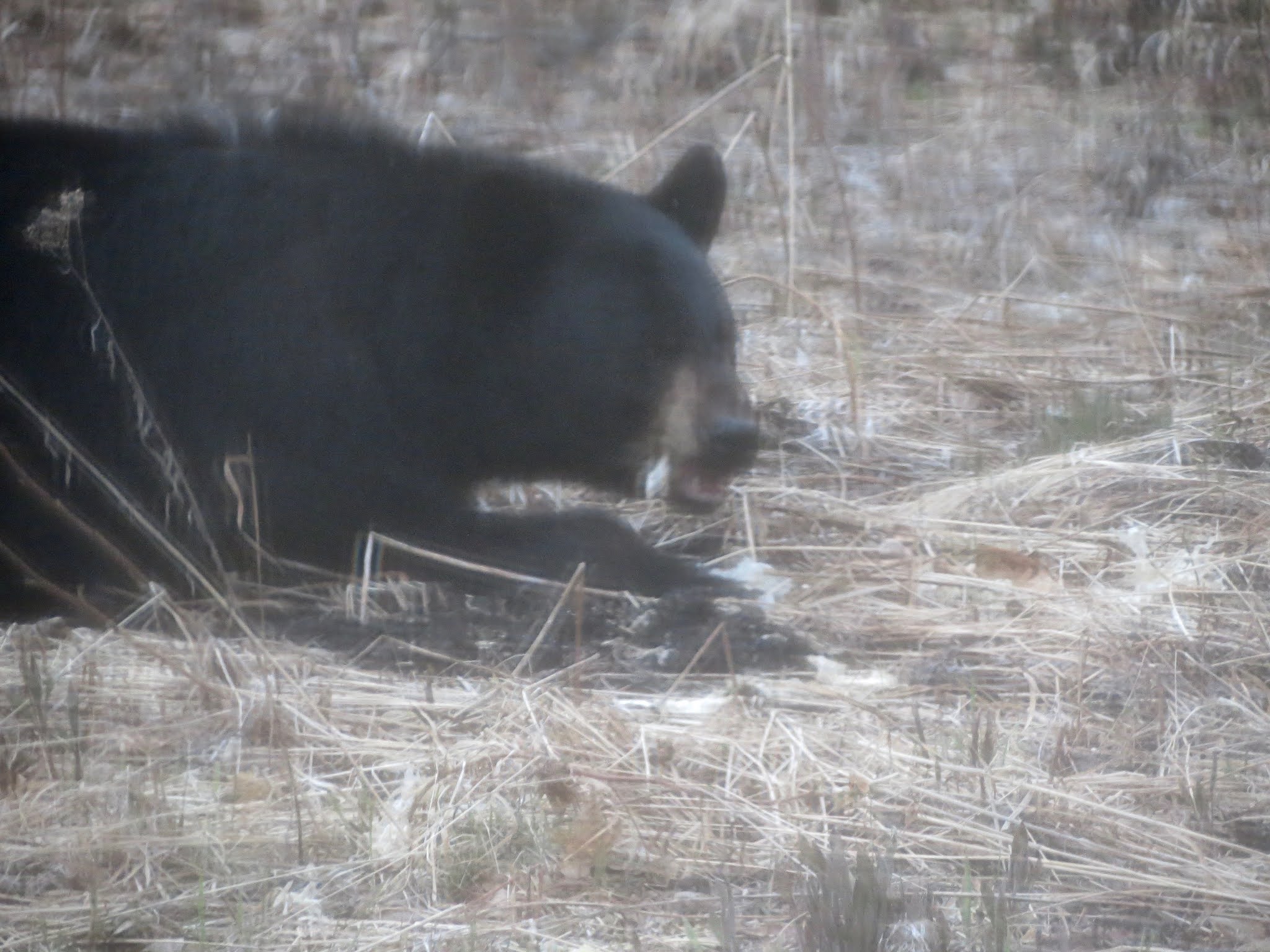


We had almost made peace with the idea that we would simply let it be when it ripped apart the chicken house (no chickens inside, only feed) which we had so carefully protected with wood, metal, and barbed wire. We realized then that when we flew back to Fairbanks the bear would most likely do the same to T's cabin as it had to the chicken house---rip it apart, steal her food, and destroy shelter for her and her boyfriend when they returned the following spring.
She insisted it had to be done.
"You do it," I said, knowing T was a better shot than I and had done this before.
So the next time the bear showed up, she walked out with her rifle, I don't remember what kind, and fired away.
And it jammed. And she couldn't get it unstuck. And the bear was pretty close.
So it was left to me, with my puny .38, to fire several shots into the black bear until it fell down dead.
Then we skinned it, and canned it, and Ms. T served it up as a kind of goulash the next day.
This is the way people used to live, I thought, chewing on my bear goulash. For many of my ancestors, this was normal. And now we get our meat wrapped in cellophane in a supermarket and cooked into whatever the latest restaurant foodie craze is.
Every meat eater should have the experience of looking your prey in the eyes and killing it. Like our ancestors did. It changes you, and it changes the way you eat. It gives what you put into your body a sense of sacredness, of knowing that something real has been offered to you, a life.
It was almost time to leave. Knowing that neither one of us really had room for it, we gave the skin of the bear back to the river, and took some of the claws, because, well I'm not really sure why, but I guess it's some way to honor the bear to keep a memory of it around.
The days were getting longer. You could walk to the river at close to midnight, look up at the wild birds swarming in the soft grey sky, listen to them calling to the last rays of sun on the water.
Return
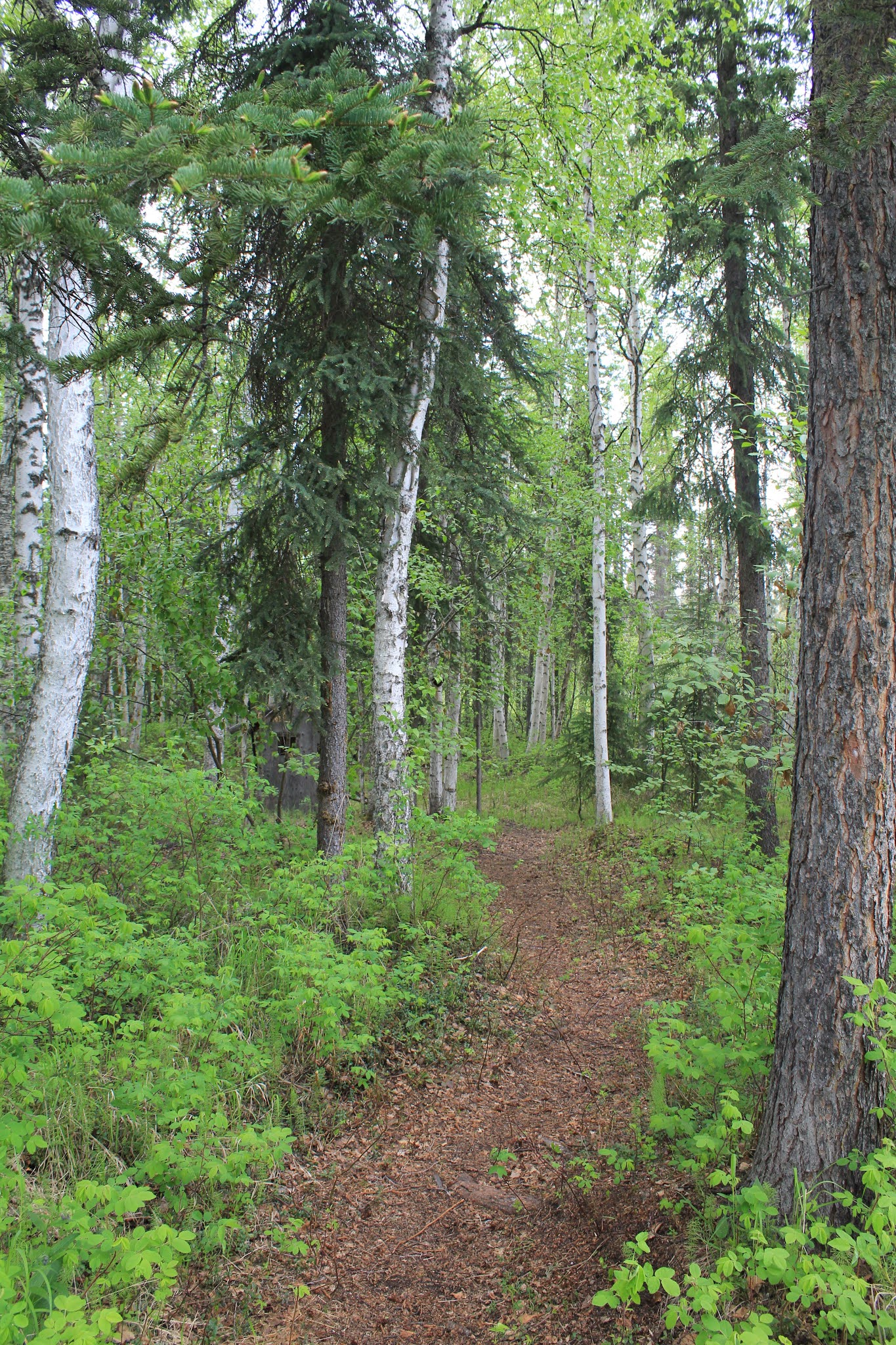


At the end of six weeks, the landscape,
as it always does, has changed. The birches are lush with green,
the clump of fireweed and other wild plants growing in front of the
cabin, (many of which I have discovered to be edible) has become a
small jungle, during the day the air is annoyingly rich with armies
of mosquitos.
Spring, as it always does, has broken
through the ice; and T and I have created another memory.
We both know that there probably won't
be another visit together to this place, in this way. In another year
or so, if all goes according to plan, she and her boyfriend will be
living here permanently, which will mean a different kind of life,
including internet connection and its invasions and distractions.
Then there is the other possibility, the one neither one of us want to talk about. That bear didn't know when he woke up in the morning what would happen by the end of the day.
“How about, next time, a trip down
the Alaskan Maritime highway?” one of us says.
“Yes” says the other. “Good
idea.”
In the few days I have left, I pick some
chiming bells and place them in water in the sunlight, then put the
water in a small bottle that I slip into my pocket. The essence of
this flower, “Joy in Physical Existence” will be returning with
me.
The day of return has arrived. We
clean up, pack up, board up the windows to the cabin, haul our stuff
back to the river and wait for the pilot, who lands this time with
skis on the water. We have to physically lift the large terrified
dog from the riverbank over the water and into the plane.
The pilot starts the engine.
We fly.
Postscript, 2021
Ms T never made it back to the cabin; her body grew weaker from liver failure and she passed away just before her birthday in 2019. She told me before she died that she was "kind of looking forward to this next adventure". I was glad to have been with her in this last trip to the Alaskan Bush, and everything it provided to both of us. I miss our long conversations, in the Bush and on the phone.
Not sure how these three images of the chiming bells appeared below, because I didn't intend to put them there. But it seems fitting there are three clumps of flowers: one for her, one for me, (still in physical existence, still mostly joyous), and one, just in case you need it, for you.


Goodbye, Ms. T, and thank you. See you around.


